Why compare TikTok accounts?
Looking at stats in isolation only tells half the story. A creator with 5 million followers sounds impressive until you put them next to a competitor with 12 million and realize the gap is larger than expected. Side-by-side comparisons force context, and context is what makes numbers meaningful. Knowing that Creator A has 200,000 more followers than Creator B is far more actionable than knowing either of their numbers alone.
The most common use cases are brand research, identifying which of two potential partners has the stronger, more established presence, and competitive analysis, where you track how a rival account is growing relative to your own. Comparisons are also useful for pure curiosity: who actually has more followers in a particular genre, or how does a large mainstream account stack up against a niche creator who punches above their weight in engagement?
How to read the comparison
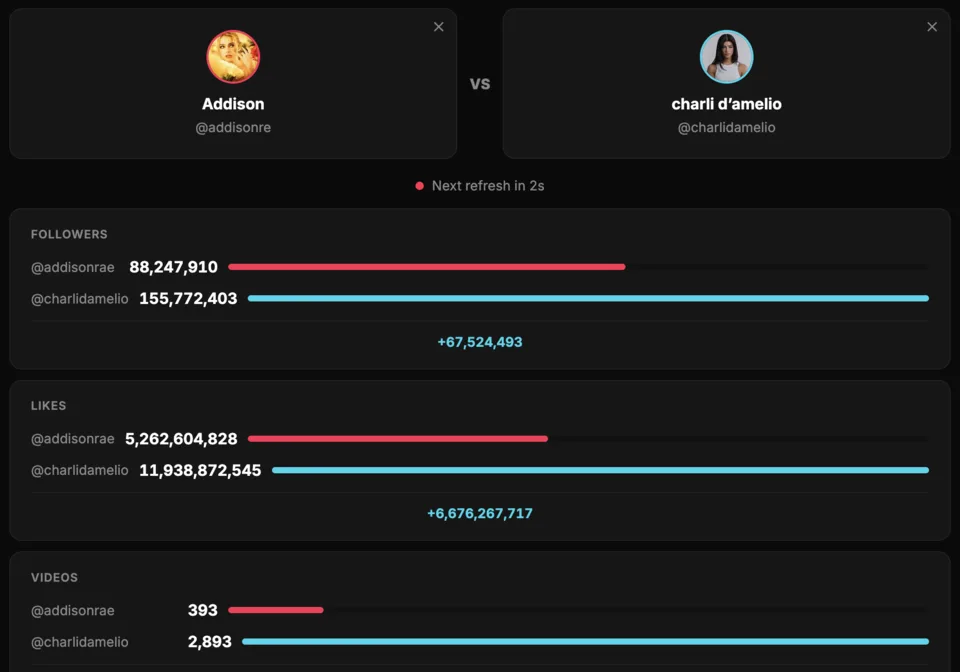
Each metric row shows both creators' numbers alongside a proportional bar. The longer bar belongs to the creator with the higher count for that stat. Below the bars, a difference readout shows the exact gap: how many more followers, likes, or videos one creator has over the other. This lets you assess the scale of the lead without mentally parsing two large numbers.
The bars are drawn relative to each other, not to any absolute benchmark. If Creator A has 1 million followers and Creator B has 900,000, Creator A's bar is full-width and Creator B's is slightly shorter. This makes the relative difference visually intuitive even when both numbers are large. When the stats are very close, the bars will look nearly identical, which is itself useful information.
Both profiles refresh simultaneously every 10 seconds, so the comparison stays current throughout a session. If one creator posts a video mid-session and it starts gaining traction, you may see their like count pulling ahead in real time. For high-activity moments (a creator going live, a viral video taking off), watching the comparison update live is a surprisingly compelling experience.
Which metrics matter most?
Followers
Follower count measures reach: how many accounts could potentially see a new video appear in their Following feed. It's the top-of-funnel metric and the one most brands look at first. However, follower count alone doesn't tell you how active or engaged that audience is. Two accounts with identical follower counts can have dramatically different levels of real influence, which is why comparing total likes alongside followers gives a fuller picture.
Total likes
Total likes measures cumulative audience response across the entire lifetime of an account. A creator with fewer followers but disproportionately high total likes is signalling that their content consistently earns reactions, a positive indicator for brands considering a partnership. When comparing two accounts, a large gap in total likes that isn't reflected in the follower gap often means one creator's content is significantly more engaging per video.
Videos as context
A creator with twice the followers but ten times the videos may have simply been posting for longer. Video count provides the context needed to interpret follower and like counts honestly. An account that reached 1 million followers with 30 videos did something very different from one that reached the same milestone with 3,000. When two accounts are close in followers, their video counts can tell you a lot about the efficiency of each creator's growth strategy.
Following
Following count is less dramatic than the others but still worth noting. A very low following count relative to followers is standard for large creators who receive far more outreach than they can reciprocate. A high following count can indicate a creator who grew through community participation, or one who used follow-for-follow tactics early on. Comparing two accounts' following counts rarely changes a decision, but it adds texture to understanding each creator's approach to their audience.